The derelict state of the Gideon estate
Black BoxThe derelict state of the Gideon estate is more than a matter of neglected buildings: the abandoned property near Zikhron Yaakov becomes the contested setting for Alexander Gideon’s plans to return, Boaz B.’s possible independence, and Ilana Sommo’s encounter with the family’s damaged past. Its ruined house and overgrown grounds stand in contrast to the restoration repeatedly imagined for them, while decisions about ownership connect private family obligations to broader political and financial schemes.
Property, Ownership, and Competing Plans
The estate is a large, empty property near Zikhron Yaakov. At one point it remains registered in Ilana Sommo’s name, although Alexander Gideon’s money helped build the villa at Yefe Nof. Manfred M. Zakheim advises her that the estate’s value has peaked and urges her to sell before the market changes. Ilana considers other uses for the property, including leaving it to Boaz B. or Michel Sommo, but also wonders whether she should make no decision yet. Her uncertainty reflects how the estate’s value is at once financial, familial, and symbolic: it can be sold, transferred, or made the basis of a new life.
Alexander’s own plans move between abandonment and repair. In one letter he imagines returning to the estate, moving into its crumbling kitchen, separating that part of the house from the rest, and restoring the building gradually. He proposes mending the fountain, replenishing the pool with goldfish, and establishing a settlement there. The scheme remains conditional and partly fanciful, but it gives the estate a future beyond sale or inheritance: a place where Alexander might live and work rather than simply dispose of property. His later correspondence with Boaz turns that possibility into a practical offer.
The property also becomes part of negotiations with political and commercial implications. Alexander writes to Michel about a proposed exchange involving land near Bethlehem and an ample building with attached grounds within the pre-1967 borders. A Paris-based financier, identified as Mr. N., has helped arrange Michel’s restored French citizenship and financed a trip to Paris connected with negotiations with a religious order headquartered in Toulouse. Alexander says the contemplated arrangement would link Bethlehem, Toulouse, and Zikhron, but notes that its completion depends partly on his own changing state of mind about selling the estate. His reluctance to sell therefore affects more than a private transaction: the property is one point in a larger plan that joins land, money, and political purpose.
The Estate as an Abandoned Place
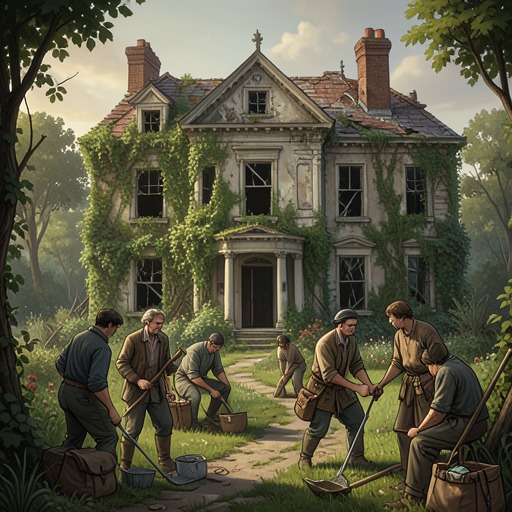
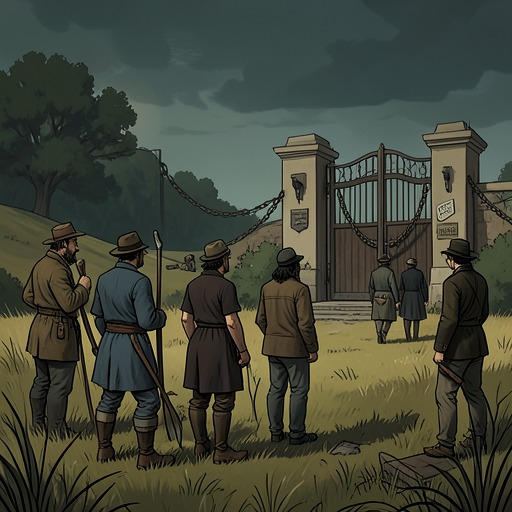
When Ilana travels to Zikhron, she finds the house inaccessible at its rusting gate, with chains and padlocks in place. The roof has collapsed, the windows are open, and bougainvillea has grown through the building. The grounds are similarly neglected: weeds and brambles cover the gardens, while oleanders have grown over the ornamental pool, fountain, and mosaic terrace. The account contrasts these remains with the former grandeur of the property, including stone sculptures that Ilana presumes have been stolen. What had been a designed landscape has become difficult to enter and harder to recognize.
Ilana waits outside for about a quarter of an hour, then walks along the fence until she finds a gap and forces her way through the barbed wire. She circles the house and reaches the rear courtyard, where she sits on a cracked bench near the garden shed and the eucalyptus tree in which Alexander built a tree house as a child. The details mark several layers of the estate’s history at once: its present disrepair, Alexander’s childhood, and Ilana’s memories of visiting it with him. The house is not simply empty; it holds traces of a family life that its current condition cannot restore.
The grounds preserve the remains of practical work as well as domestic memory. Near the shed Ilana sees a rusty plow, a dismantled rake, and large wooden wheels partly buried in the earth. She recognizes the broken marble slab supported on three tree stumps as what remains of the garden table where she and Alexander once sat together. Her account recalls that Alexander first brought her to the estate to show her to his father or impress her with the family’s magnificence. The ruined table makes that remembered introduction present in the landscape, but only as a damaged remnant.
The estate’s isolation is relative rather than complete. The town has expanded toward the house without quite reaching it, and newer homes stand down the slope. From the property Ilana can see wooded hills to the east and the sea to the west. She also recalls the neighboring kibbutz’s fish ponds and Alexander’s fierce campaign against them, which she and Zakheim helped defeat and confine. The setting thus contains both encroaching modern development and the memory of an earlier dispute over the surrounding land.
Boaz’s Offer and the Meaning of Restoration
Alexander offers Boaz a choice between going to America and living at the house near Zikhron Yaakov. He acknowledges that the property is in poor condition but argues that Boaz has the practical ability to begin restoring it. Alexander promises a fair monthly wage and payment for building materials, and says Boaz may invite anyone he likes to live there. He also points to the possibility of agriculture and the house’s proximity to the sea, while making the offer conditional on Boaz’s freedom to do what he wants. The proposal makes the derelict estate a concrete alternative to dependence on the family’s money: work on the property could provide Boaz with a place and a degree of self-direction.
Ilana later visits Boaz at the property and sees the emotional cost of Alexander’s decision to send him there. She asks whether Alexander placed their son in the house to defeat Michel in a contest over the family or to separate Boaz from the developing affection between them. These are Ilana’s suspicions, not established motives, but they show how the estate functions within the family conflict: it can shelter Boaz and offer him independence, yet it can also become a means of distance. The ruined setting intensifies that ambiguity without resolving it.
Narrative and Familial Significance
The estate’s condition is presented through competing perspectives. Alexander imagines repair in deliberate stages: a room in which to live, a mended fountain, a restocked pool, and a settlement. Ilana encounters a roofless, overgrown house and the broken remains of shared memories. Boaz receives an offer of paid restoration and personal freedom, while Ilana fears that his placement there may have weakened a new bond between mother and son. The same property can therefore appear as a project, an opportunity, a refuge, or an instrument of separation, depending on who is looking at it and what they hope it will do.
The estate also concentrates the novel’s questions about inheritance and obligation. Alexander wonders whether to sell, transfer, or retain it; Michel’s political and business plans are affected by whether it becomes available; and Boaz is offered access to it through labor rather than an immediate transfer of ownership. Its dereliction does not settle who should possess it. Instead, the contrast between visible decay and repeated promises of restoration keeps the property’s future open, making the neglected house a material measure of how difficult it is for this family to turn memory, money, and care into a shared home.